


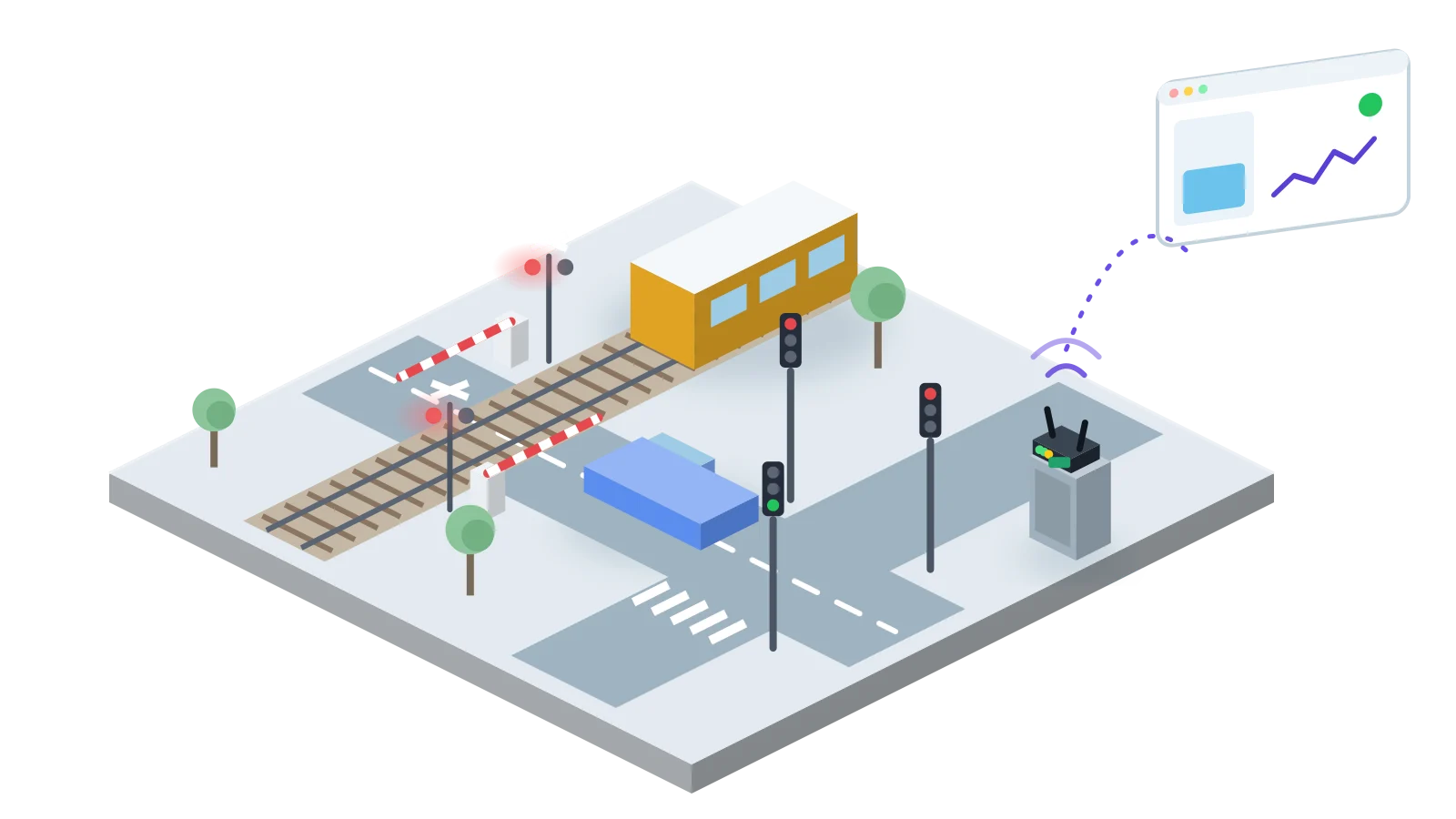
Without data vs with Hermetry
Barriers come down at 07:52 and stay down. Who knows first?
The same morning at one tram crossing, twice: once with nobody watching the crossing, once with Hermetry watching it.
Without data
until someone knows
48 min
The maintainer hears of it from the street, through the control room.
Thu 07:52
The barriers at Crossing 3 come down and stay down
No tram is coming. Cars queue on both sides.
Thu 08:10
The queue reaches the next junction
Buses on two routes are held in it.
Thu 08:25
A driver calls the city
The call is passed on to the traffic control room.
Thu 08:40
The crossing maintainer is called
Forty-eight minutes after the barriers came down.
With Hermetry
to the first alarm
10 min
A Rules card on the corridor raises "Barriers held down" when a crossing’s barriers stay down for 10 minutes.
Thu 07:52
The barriers at Crossing 3 come down and stay down
The crossing controller reports barriers down.
Thu 08:02
Major alarm: Barriers held down
The barriers have stayed down for 10 minutes. This is what the control room sees:
- Barriers held down Crossing 3 · Major
- Mains restored Junction 12
- Signal lamp failure Junction 9 · Minor
- Cabinet door closed Crossing 1
Thu 08:03
The control room and the crossing maintainer get a push
It repeats every 15 minutes until someone acknowledges it.
Thu 08:20
The maintainer is on site
The alarm is acknowledged with a note and resolves when the barriers rise. Its history is kept.
At a glance
| Item | Typical answer |
|---|---|
| Problem | A crossing controller or a signal controller records a fault in its own cabinet, but the street finds out first: a lamp out, barriers stuck down, or a junction on flashing amber in the morning peak. |
| What is connected | The status outputs of each level crossing controller (healthy, fault, barriers down, lamp failure), mains and battery at the crossing, and the fault, lamp and power states of each traffic signal controller. |
| Who uses it | The traffic control room, the signals maintenance contractor, the crossing maintainers of the tramway or railway, and the road authority's duty officer. |
| Typical first scope | Five to ten crossings or junctions of two controller types, usually along one corridor. |
| Time to first screen | Typically a few days after the first cabinet is wired, because the signals are contacts and a battery voltage. Allow four to six weeks before maintainers rely on the alarms instead of patrols. |
The situation
A city has signalled junctions on its main roads and, where trams or a railway cross the street, level crossings with barriers, warning lights and a crossing controller. Each controller checks its own lamps and equipment and records faults in its cabinet. Some report to a central system of their own; many older ones report to nobody.
So faults are found from the street. A red lamp fails and a driver reports it. Barriers stay down after a fault and traffic queues before anyone is sent. A junction drops to flashing amber at 08:00 and the contractor hears of it from the police. A crossing on standby battery after a mains failure runs until the battery is flat, and nobody saw the voltage fall.
This blueprint reads the status that controllers already provide for remote monitoring, adds mains and battery, and puts every crossing and junction on one map with alarms to the right maintainer. It reads. It never takes part in the controllers' safety logic.
What gets connected
Signals are status outputs the controller provides for monitoring, read on gateway inputs, or registers where a controller offers Modbus. Their names and meanings vary by controller type; agree them with the owner.
| Point | Telemetry key | Unit | Source | Interval | Notes |
|---|---|---|---|---|---|
| Crossing healthy | xing_ok | bool | Controller status output | on change | The controller's own summary. |
| Crossing fault | xing_fault | bool | Controller fault output | on change | |
| Barriers down | barrier_down | 0/1 | Controller monitoring output | on change | Used by the held-down rule. |
| Warning lights active | lights_active | 0/1 | Controller monitoring output | on change | |
| Crossing lamp failure | lamp_fail | bool | Lamp-proving output of the controller | on change | Warning light or road signal lamp. |
| Mains present | mains_ok | bool | Phase relay on a gateway input | on change | At crossings and junctions. |
| Standby battery voltage | battery_v | V | Gateway analog input through a transducer | 5 min | Crossing standby supply. |
| Cabinet door open | door_open | bool | Reed contact | on change | Explains visits on the timeline. |
| Signal controller fault | tsc_fault | bool | Controller fault output, or Modbus | on change | |
| Junction mode | tsc_mode | code | Controller mode outputs | on change | 0 normal, 1 flashing, 2 dark. |
| Signal lamp failures | lamp_fail_count | count | Controller, where it reports a count; else a lamp-fail contact | on change | |
| Vehicles per hour | veh_per_h | veh/h | Controller detector counts, where offered | 15 min | Optional. |
How it is set up
- Gateways: a 4G gateway in each crossing and junction cabinet, or an industrial gateway running Hermetry Edge where a cabinet has a network link, reads the status outputs on its digital inputs, the battery voltage on an analog input and, where a controller offers it, registers over Modbus RTU. It sends them over MQTT over TLS on one outbound connection; nothing on the street accepts connections from the internet.
- Wiring: only to outputs the controller provides for remote monitoring, through isolated contacts, and approved by the controller's owner. Nothing is wired into the crossing's or the junction's safety circuits.
- Buffering: readings are kept on the gateway while the link is down and arrive later with their original time stamps; capacity depends on the model.
| Component | Role | Notes |
|---|---|---|
| Crossing controller | Keeps control of barriers, lights and the crossing sequence | Read-only from Hermetry, through its monitoring outputs. |
| Traffic signal controller | Keeps control of the junction | Read-only from Hermetry. |
| 4G gateway | Reads contacts and battery voltage in the cabinet | One per cabinet; claimed into your organisation. |
| Industrial gateway with Edge | The same, where a cabinet has a network link or a controller offers Modbus | Each controller can report as a child device. |
| Hermetry | Storage, alarms, map, boards | EU, US or Türkiye region, or on your own servers with the Enterprise plan. |
Use one profile for crossings and one for junctions, duplicated per controller type, because rules address devices one by one or by profile. In the asset tree, a corridor is an area and each crossing or junction a site beneath it, with its location, controller type, maintainer and battery limit as attributes.
Heartbeats. Contacts report on change, so without a heartbeat a quiet crossing and a dead link look the same. Have each gateway report every few minutes and use the Recent message online rule with that interval.
Testing at the cabinet. With the maintainer, force a fault, a lamp failure and barriers down from the controller's own test function where it has one, and check that each state changes in Hermetry within a minute and that the alarm reaches the right person.
Alarms
| Alarm | Condition | Delay and hysteresis | Severity | Notified | Escalation |
|---|---|---|---|---|---|
| Crossing fault | xing_fault == true | Debounce 10 s | Critical | Crossing maintainer on call and control room, SMS and push | Reminder every 10 min until acknowledged |
| Barriers held down | Rules card on the corridor: barrier_down = 1 | Stays so for 10 min | Major (raised by the rule) | Control room and crossing maintainer, push | Reminder every 15 min |
| Crossing lamp failure | lamp_fail == true on the crossing profile | Debounce 30 s | Major | Crossing maintainer, push and SMS | Reminder every 30 min |
| Crossing on battery | mains_ok == false on the crossing profile | Debounce 60 s raise, 120 s clear | Warning | Control room, in-app | Covered by the battery alarm |
| Crossing battery low | battery_v < attribute battery_low_v | Debounce 3 readings; hysteresis 0.5 V | Major | Crossing maintainer, SMS | Reminder every 30 min |
| Junction dark or flashing | tsc_mode > 0 | Debounce 30 s | Critical | Signals contractor on call and control room, SMS | Reminder every 10 min |
| Signal controller fault | tsc_fault == true | Debounce 30 s | Major | Signals contractor, push | Reminder every 30 min |
| Signal lamp failure | lamp_fail_count > 0 | Debounce 2 readings | Minor | Signals contractor, e-mail | Reminder daily |
| Junction mains lost | mains_ok == false on the junction profile | Debounce 60 s | Major | Signals contractor and control room, push | Reminder every 30 min |
| Gateway offline | Inactivity rule, no message for 10 min | Major | Control room, push | Reminder every 30 min |
Consequences, not dips. A mains failure at a crossing is a Warning, because the standby battery carries it. What pages people is the battery falling. Put limits that differ by site, such as battery_low_v, in attributes so one rule fits every crossing.
Held down. A busy tram line can keep barriers down for minutes at the peak. Agree the held-down time with the crossing owner, and use a Rules card, whose timer runs even when no new reading arrives.
Maintenance. Mute a crossing or junction while the maintainer works in the cabinet. Its alarms are recorded but nobody is paged, and the mute ends by itself. Limits and times here are starting values; take them from the controller owner and the maintenance contract.
Dashboards and screens
| Board | Audience | Widgets and what they show |
|---|---|---|
| Corridor map | Control room | Map of crossings and junctions coloured by status; table with mode, faults, mains and battery; alarm table filtered to Major and Critical. |
| Crossing page | Crossing maintainer | State cards for healthy, barriers and warning lights; gauge for battery voltage; line chart of battery voltage over 7 days; the crossing's alarms with their notes. |
| Junction page | Signals contractor | State cards for mode, fault and mains; lamp failures; mode changes over 24 hours; vehicles per hour where counted. |
| Maintenance review | Contractor manager | Faults per site and month; time to acknowledge from the alarm timeline; tables downloaded as spreadsheets. |
Entity parameters let one Crossing page serve every crossing and one Junction page every junction, opened from a map marker or a table row.
A SCADA drawing of a corridor places the level crossing and traffic light symbols of the city family where they stand, with the controller beside each. Colour rules show a fault in red, a flashing junction in amber and a low battery as a second reading. Leave every command out of these drawings: barriers, lights and signal plans stay with their controllers.
Rollout
| Phase | Weeks | Work | Exit criteria |
|---|---|---|---|
| 0. Survey | 1-3 | List controllers and their monitoring outputs; agree meanings and wiring with each owner; check cellular coverage at the cabinets. | Approved wiring list per controller type. |
| 1. Pilot | 4-7 | Two crossings and three junctions; profiles; alarms to the control room only; corridor map. | Every output tested at the cabinet with the maintainer; alarms seen within a minute. |
| 2. Corridor | 8-12 | All sites of the corridor; routing to maintainers and the contractor; battery limits per site. | Two weeks in parallel with patrols; no fault found in the street first. |
| 3. City | 13 on | Remaining corridors in turn; maintenance review board; signed webhooks to the contractor's job system. | Every site reporting; faults acknowledged within the agreed time. |
Pitfalls
- Wiring into safety circuits. Use only outputs the controller provides for monitoring, through isolated contacts, with the owner's approval.
- Paging on every mains dip. Crossings carry standby batteries. Page on the battery, not on the dip.
- One profile for every controller type. Output meanings differ. Duplicate the profile per type and map each to the same keys.
- A gateway on the cabinet's own supply. At a junction without standby power, a mains failure takes the gateway with it and shows as “Gateway offline”. Give the gateway a small backup supply, or read offline as power lost.
- A silent cabinet that looks healthy. A gateway without a link shows its last good state. Keep an inactivity alarm on every gateway.
What Hermetry does not do
Hermetry measures and alarms; it does not control level crossings, barriers, warning lights, traffic signals or trains. The crossing controller, the signal controller and the railway's or tramway's signalling keep full control and every safety function, and must work without Hermetry or its link. An alarm in Hermetry tells people; it is no part of the crossing's protection. Signal timings, crossing sequences and maintenance stay with their owners.